Why Merz’s Visit Matters
German Chancellor Friedrich Merz’s official visit to India — his first to Asia after taking office — underscores a strategic recalibration in Germany’s foreign and economic policy. With global power shifts, protectionist tendencies in major economies, and geopolitical uncertainties, Germany appears intent on deepening ties with India — one of the world’s fastest-growing large economies.
Economists and geopolitical strategists see this as a mutually beneficial pivot: Germany seeks to diversify trade away from China and bolster access to emerging markets; India seeks technology transfer, investment, and strengthened global partnerships.
During the visit, India and Germany signed numerous agreements (about 19 MoUs/JDI/Declarations) covering defence, technology, energy, telecommunication, skills mobility, health, and more — reflecting a broad and deepening partnership.
📊 1. Strategic Economic Agreements
▪ EU–India Free Trade Agreement Momentum
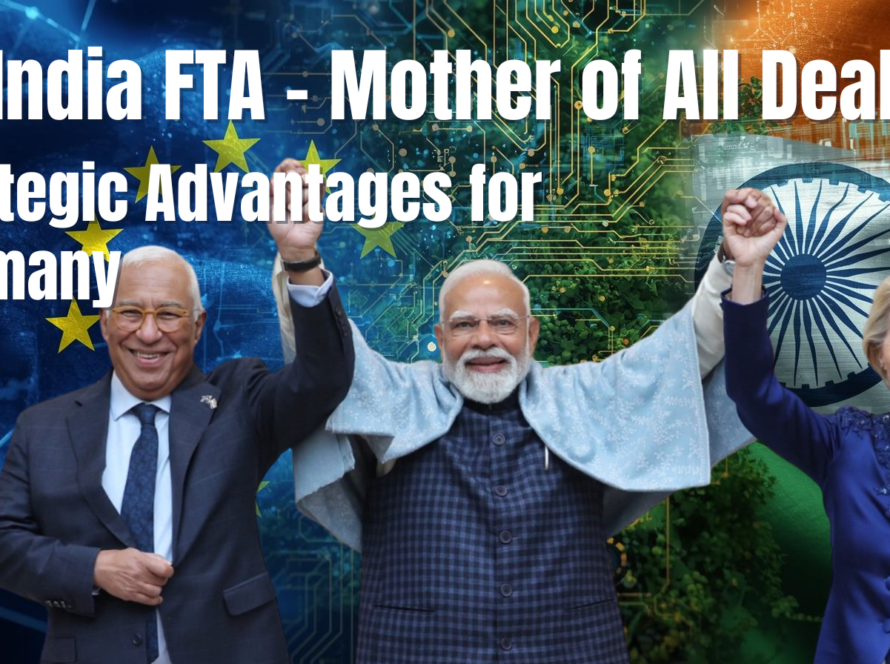
Though not a final India–Germany bilateral trade pact, Merz publicly supported the EU–India Free Trade Agreement (FTA) and suggested it could close by the end of January 2026. This pact, once concluded, would tomorrow unlock tariff and non-tariff barriers on goods and services between India and the entire EU bloc, of which Germany is the largest economy.
A comprehensive EU–India FTA could boost bilateral trade by reducing tariffs, giving Indian exporters (and workers) better access to EU markets. It also sends a signal of trust in India’s regulatory convergence with the EU — a key confidence factor for investors. Analysts argue this can significantly benefit service sectors like IT, engineering, and healthcare — areas where Indian professionals are globally competitive.
🛠 2. Sector-Specific Deals and Their Impacts
▪ Defence and Security Industrial Cooperation
A Joint Declaration of Intent was signed to establish a Defence Industrial Cooperation Roadmap for co-innovation and co-production, underlining joint design, co-development, and technology sharing.
Co-production pacts help transfer advanced skills to Indian industry and workforce, encouraging Indian engineers and technicians to participate in high-technology manufacturing — a boon for professionals in mechanical, aerospace, and systems engineering.
India’s defence industry — historically reliant on foreign imports — could see upskilling and improved competitiveness as German partners introduce stringent quality standards and project management disciplines.
▪ Technology, Telecom and Digital Cooperation
A Joint Declaration on Telecommunications Cooperation was signed, establishing a framework for regular consultations and joint work across ICT and emerging tech areas.
Collaboration in telecom and digital tech reflects recognition of India’s rapidly growing digital ecosystem and Germany’s advanced tech capabilities. Joint efforts can spur co-innovation in 5G/6G rollout, semiconductor research, IoT, and AI — fields where demand for skilled professionals is surging.
This agreement is especially relevant for Indian software engineers, network specialists, data scientists, and cybersecurity professionals — both in Germany and globally — as it fosters cross-border R&D projects, talent exchanges, and employment opportunities.
▪ Renewable Energy & Green Hydrogen offtake
Energy cooperation includes a long-term agreement where German energy company Uniper will purchase large quantities of green ammonia (a hydrogen derivative) from India, supporting sustainable energy goals.
Green energy collaboration aligns with global decarbonisation trends and can create new career paths in renewable energy, hydrogen production, and environmental engineering. Indian professionals with expertise in energy systems could find opportunities in Germany’s expanding green economy, particularly if companies leverage bilateral supply chains.
▪ Postal, Logistics, and Other Trade Facilitation
Agreements were signed to deepen cooperation in postal, express, and logistics services, which facilitates trade and cross-border e-commerce flows.
Logistics and trade integration may indirectly boost jobs in supply chain management, international trade compliance, and e-commerce operations for professionals with relevant expertise.
👩🎓 3. Mobility, Skills, and Education Agreements
One of the most directly relevant aspects for Indian professionals is the set of agreements focused on mobility, skills partnerships, and professional movement:
▪ Visa-Free Airport Transit and Mobility Facilitation
Germany announced visa-free transit at airports for Indian passport holders, making travel for work and study easier — although this isn’t a full work visa reform, it is a symbolic step toward flexibility in mobility.
▪ Global Skill Partnerships and Healthcare Mobility
Agreements include a Joint Declaration on Global Skill Partnerships, aimed at ethical and sustainable recruitment of healthcare professionals — a sector where Germany faces acute workforce shortages.
Professional impact:
- Indian healthcare workers (nurses, caregivers, allied health professionals) could see streamlined pathways into Germany’s labour market, backed by frameworks that protect fair recruitment and workers’ rights.
- The agreements also support skill certifications and vocational training cooperation, making Indian qualifications more recognised and compatible with German standards.
▪ Higher Education and Training Initiatives
An Indo-German Roadmap on Higher Education and cooperation on Centres of Excellence for Renewable Energy training were also agreed.
These initiatives boost academic exchanges, research collaborations, and worker skill development — benefitting students and professionals who might pursue collective programmes or qualifications recogniseable in both countries.
📈 4. Economic and Labour Market Implications
A. For Indian Professionals Already in Germany
Increased demand — especially in healthcare, engineering, and IT: Germany’s aging population and labour shortages in crucial sectors (healthcare, tech, engineering) mean continued demand for skilled immigrants. The new agreements signal ongoing recognition of Indian talent as a strategic labour source.
Better frameworks for integration: The Government-to-Government dialogues and skill partnerships may standardise credential recognition and training alignment — reducing barriers for Indian professionals seeking long-term employment or permanent residency options in Germany.
Higher wages and career growth: Proficiency in German language and cross-certification through joint training programmes can lead to premium wages and leadership roles.
B. For Indian Professionals Who Want to Come to Germany
More predictable entry pathways: Although not radical immigration reform, the emphasis on ethical recruitment frameworks and streamlined visa transit arrangements suggests a political will to ease access — particularly in sectors with labour shortages.
Enhanced employer networks: Cross-border industry partnerships (e.g., defence co-production, digital tech cooperation) create informal pathways into multinational projects and German companies operating in India — benefitting professionals with international experience.
Education-to-employment pipelines: Cooperation in education and training strengthens student exchange and joint academic programmes, which often serve as pipelines into work opportunities post-graduation.
🔍 5. Broad Economic Commentary from Analysts
Trade and Investment Diversification: Economists see India–Germany cooperation as a hedge against global supply-chain risks — Germany gains access to India’s growing market and talent reservoir, while India taps German technology and capital.
Tech and Innovation Synergy: Germany’s manufacturing and engineering prowess paired with India’s digital scale and cost competitiveness can lead to innovation hubs, R&D centres, and joint ventures — fuelling job creation on both sides.
Geopolitical Stability: In an era of great-power rivalry and protectionism, strengthening ties enhances strategic autonomy for both countries — a factor that economists believe will encourage long-term investment flows and economic predictability.
📌 Summary: What This Means for Indian Professionals
For those already in Germany:
- Greater opportunities in healthcare, engineering, ICT, renewable energy, and defence sectors.
- Frameworks for skills recognition, certification, and mobility are improving.
- Visa facilitation measures and bilateral accords may ease career progression.
For those wanting to move to Germany:
- A clearer policy focus on skilled worker mobility could lower barriers to entry.
- Industry cooperation agreements improve job prospects in high-demand sectors.
- Education and training partnerships help build bridges into German job markets.
📍 Conclusion
Chancellor Merz’s visit to India and the resulting bilateral agreements signal a strategic deepening of ties that reach far beyond diplomacy — they have material implications for trade, investment, technology, skills mobility, and labour markets. Economist commentary suggests these agreements will strengthen India’s integration with global value chains and expand opportunities for Indian professionals within Germany across multiple sectors.
If the momentum toward an EU–India Free Trade Agreement continues to build, the combined effect could be transformative — not just for corporate trade volumes, but for individual careers and cross-border labour mobility between two of the world’s most dynamic economies.
References :
https://www.pmindia.gov.in/en/news_updates/india-germany-joint-statement/
Image Credit : Narendra Modi Official X account and Canva
Research Support : ChatGPT